Beyond ‘Good Kids’: Why We Underestimate What Our Toddlers Can Do
It’s Saturday, the one day you’re supposed to be able to breathe, but the house is already a whirlwind of chaos. One kid is demanding the specific cartoon that only comes on at 7:02 AM, while the other is refusing to put on anything but a superhero cape. You’re trying to get everyone washed, dressed, and fed, a process that feels less like parenting and more like herding caffeinated squirrels.
By the time you finally wrestle them into the car, late for whatever you were trying to get to on time, the living room looks like a toy store exploded and you feel utterly spent. You glance at your spouse and share a look that says, “This is just what it’s like, right?”
It’s a familiar script in millions of homes. We look at our toddlers, with their boundless energy and still-developing brains, and we chalk up the daily battles to a phase. We tell ourselves that as long as they’re not giving us *too* much trouble, we’re doing a decent job. We see the screaming, the messes, and the refusal to cooperate as just “normal childhood difficulties.”
But what if that’s not the whole story? What if, in our loving attempt to be patient and understanding, we’ve accidentally set the bar so low that we’re tripping over it?
The ‘Good Kid’ Trap
Let me tell you about a couple, John and Theresa. They have a three-year-old and a 20-month-old, and they sound like great parents. They have a strong marriage and they love their kids. But they are getting worn down.
Their son, Joe, doesn’t sleep through the night, so after months of exhaustion, they brought him into their bed. It stopped the crying, but now nobody gets great rest.
Their daughter, Christina, woke up hungry in the middle of the night—after a candy-fueled afternoon—and they patiently got up and gave her chocolate milk and cookies.
When it’s time to go to Grandma’s, getting the kids ready is an exercise in screaming, rushing, and confusion. Theresa ends up just turning on the TV and dressing them while they’re distracted, and then tidies the entire apartment herself because it’s faster.
At every turn, they find a short-term solution to keep the peace. They use bribes, distractions, and empty threats, all while feeling like they’re just doing what parents do.
After a particularly trying day, John sums up their philosophy perfectly. “Despite a few behavior issues which seem to me totally normal, they’re good kids,” he says. “You and I were brought up pretty much the same way and we haven’t turned out so badly.”
And there it is. The ‘Good Kid’ Trap. We see the good in our children, we love them fiercely, and so we write off the exhausting, frustrating, and chaotic parts of our day as normal. We assume that this is just the price of admission for having toddlers.
But this mindset, while well-intentioned, completely underestimates what our children are capable of and, in the long run, what they need from us.
The High Cost of Low Expectations
When we constantly smooth the path for our children, we aren’t just making our own lives harder; we’re robbing them of essential opportunities to grow. The truth is, character isn’t something you start building in grade school. It begins in the cradle.
From their earliest days, children are learning how the world works. They are learning whether their crying instantly produces a parent, whether a tantrum gets them a cupcake, and whether a mess is something they are responsible for.
When a child’s immature desires are routinely gratified, they get into the habit of insisting that their demands always be met. This isn’t because they are bad or manipulative; it’s because it’s the only system they know.
They find it difficult to do things that are beneficial but not immediately appealing. Over time, their demands become more insistent, more imperious. The spoiled child bluntly put “in the end makes both himself and others miserable.”
This isn’t about being harsh or unloving. Quite the opposite. It’s about understanding that a child who has never learned to manage a little frustration, delay gratification, or accept a “no” is not a happy child. He is a child at the mercy of his every impulse, and that is a frightening and unstable way to live.
The real work of early parenting isn’t just keeping our kids safe and fed; it’s helping them develop the habit of self-control, which is the foundation of a peaceful and happy life.
The First Battleground: Sleep
For most of us, the first major struggle is sleep. It’s the original parenting crucible, and it’s where our expectations are first put to the test.
When John and Theresa brought their son Joe into their bed, they did what millions of exhausted parents do: they chose the path of least immediate resistance. It stopped the crying, but it created a new reality where a toddler’s restlessness dictated the sleep of the entire family. It weakened his independence and put a strain on his parents.
Good sleep habits are the first area where a child learns that he doesn’t always get what he wants the second he wants it. The challenge for us as parents is to resist the temptation to comfort our baby every single time she protests.
Of course, a two-month-old who is hungry or in pain needs us. Empathy and flexibility are non-negotiable. But as they grow, we need to distinguish between a cry of real distress and a cry of protest. Tears and protests while a baby is learning to settle herself for the night don’t automatically mean something is wrong.
If we respond to every outburst, the child learns a simple but powerful lesson: making a fuss gets me what I want. It’s not fair to a child to teach her that a crying fit is the most effective tool in her arsenal. The goal is to teach our babies that their needs will always be met, that they are deeply loved and cared for, but that crying does not control the situation.
By establishing a predictable, consistent routine, we are giving our child the gift of uninterrupted sleep and the first, crucial skill of self-settling.
More Than Just a Meal
The second arena where our expectations shape our children’s character is the dinner table. Think about Christina getting cookies and chocolate milk in the middle of the night, or the daily mealtime battle where she refuses to stay in her chair.
At her grandparents’ house, the meal is so chaotic that Grandpa resorts to bribing her brother with candy just to get him to eat his chicken.
We often treat meals as a simple transactional process: get calories into the kid. But it’s so much more than that. When we instill a habit of three regular meals and a couple of planned snacks, we are teaching them a whole suite of virtues.
The child learns to cope with a growing appetite in anticipation of mealtime, which is a fundamental exercise in self-discipline. They learn that the family comes together at a specific time, reinforcing their place within a loving community.
Resisting the temptation to offer a constant stream of snacks or to “top up” a child between meals is not about being rigid. It’s about helping them arrive at the table actually hungry and therefore more likely to eat well and try new things.
When we see family members enjoying a variety of foods, it becomes a powerful lesson. This approach transforms mealtime from a battlefield of wills into a moment of connection and formation. It teaches a child that some things are worth waiting for.
The Surprising Competence of a Three-Year-Old
Here’s where we really tend to sell our kids short. After a chaotic morning, Theresa’s solution to the toy-strewn apartment is to send her husband and kids to the car so she can clean it up herself. Why? Because it’s faster. It’s more efficient. And every parent reading this has done the exact same thing. We’re in a hurry, and it’s just easier to do it ourselves.
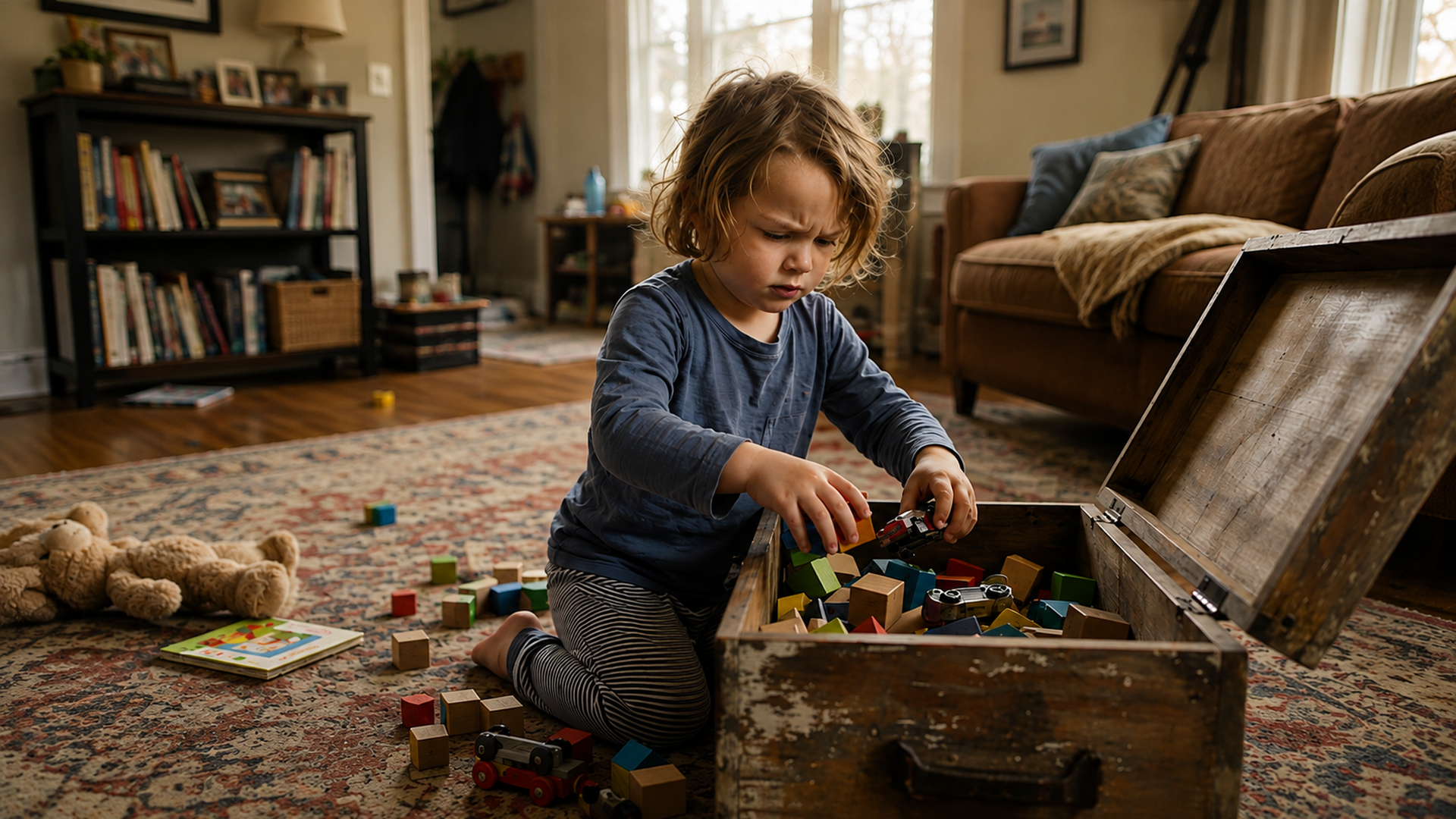
But what if the goal isn’t just a clean house? What if the goal is a capable child? For example, three-year-olds are perfectly capable of putting away their own toys and clothes, helping a parent make a bed, and even handling certain items during cooking or cleaning.
These are not just chores; they are formative experiences. They teach self-reliance and cooperation. More than that, they give a child a sense of satisfaction and confidence, a feeling of being a contributing member of the family team.
When we affectionately insist that a child completes the small task they’ve been assigned, we’re teaching them a profound lesson. We are telling them, “You are a part of this family, and your contribution matters.”
The point is not order for the sake of order. It’s that the routine of performing small tasks of service gives a child a greater capacity to want the good of others. And that is a working definition of love. Doing it for them to save time is a missed opportunity to build their character.
The Real Goal of Discipline
So much of this comes down to how we understand authority and discipline. For many of us, the words feel negative, conjuring images of punishment and control. But that’s a misunderstanding of their true purpose. The purpose of discipline is to move a child toward genuine freedom—the freedom to control their own impulses and make good choices.
A child is not born with an internal compass. It’s our job to help them build one. Discipline, when exercised in a climate of trust and love, provides the child with internalized norms of conduct.
They discover and make their own the values that govern mature behavior. A child who knows what is expected of them, who understands the boundaries, is not a repressed child. They are a secure child. They are peaceful and happy because predictability and repetition make them feel safe.
This requires us, as parents, to be on the same page. A child is easily confused by conflicting approaches, like when one parent is firm and the other is permissive. It also requires us to be consistent. If we decide that hands get washed before dinner, we must ask for it every time.
If we decide coats get hung up, we must gently insist on it every time. This isn’t about being a drill sergeant. It’s about providing the steady, reliable guidance that allows a child’s will to grow strong. It’s about being able to say with love, “I know you’re upset, but what your mother and I have said doesn’t change, because we want what’s best for you.”
From Management to Formation
If all of this sounds like more work, I get it. We’re all stretched thin. But this isn’t about adding a dozen new rules to your family life or striving for perfection. It’s about a fundamental shift in perspective. It’s about moving from simply *managing* our children’s behavior day-to-day to intentionally *forming* their character for the long haul.
It’s about seeing the toddler years not as a chaotic phase to be survived, but as the critical window for laying the foundation of a happy, responsible, and capable adult.
It’s realizing that every interaction—from a bedtime protest to a messy meal to a floor full of toys—is an opportunity.
It’s a chance to teach fortitude, self-control, generosity, and patience.
Raising our expectations for our toddlers is not an act of harshness; it is an act of profound love and respect. It is a declaration of our confidence in their ability to grow and learn. It is the belief that our children are capable of more than just being “good kids” who are getting by.
They are capable of becoming great people, and the work starts now, with the small, consistent, and loving expectations we set for them today.