My Child Won’t Sleep: Why Co-Sleeping Isn’t Always the Answer (and What Is)
It’s two in the morning, and the house is dark except for the faint glow of a nightlight. You’re standing by your toddler’s bed, listening to the kind of crying that feels like a personal accusation. You’ve tried everything: a drink of water, another story, the gentle back rub, the firm command.
Nothing works.
You’re so tired your bones ache, and the thought of getting up for work in a few hours feels like an impossible mission. In that moment of sheer desperation, you do the one thing you know will work. You scoop him up, carry him back to your room, and tuck him in between you and your spouse.
The crying stops. Silence descends. It feels like victory.
But as the weeks turn into months, you realize it wasn’t a victory; it was a truce. And you’re the one who surrendered.
This is the exact situation my friends John and Theresa found themselves in. They were good, loving parents to their three-year-old, Christina, and 20-month-old, Joe. But they were exhausted. Joe just wouldn’t sleep through the night, and they were getting up five or six times to resettle him.
They reassured themselves it was normal, the kind of thing all parents go through. Eventually, worn down and desperate for rest, they brought Joe into their bed. And it worked. He slept. But they didn’t.
The Co-Sleeping Solution That Isn’t a Solution
Six months into their new arrangement, John and Theresa were still tired. Joe, it turned out, was a human helicopter blade in his sleep, constantly moving and kicking. John, in particular, was having a hard time adjusting to the cramped, restless nights.
But since it kept Joe from crying, he figured the inconvenience was worth it. The problem was, they were stuck. Any attempt to sneak Joe back into his own crib was met with an immediate, full-throated protest.
The short-term fix had become a long-term habit, and nobody was happy about it.
It’s a trap so many of us fall into, and it comes from a place of love and sheer exhaustion. We just want the crying to stop. We just want some sleep.
But allowing young children to sleep habitually in their parents’ bed is a temptation to be resisted. Why? Because “the longer this practice continues, the harder it is to break.”
More than that, it subtly “weakens the independence and confidence of a child, not to mention the strain it can put on the parents.” The quiet we buy in the middle of the night comes at a high price: our own rest, our marriage, and even our child’s development.
John and Theresa thought they had solved a sleep problem. What they had actually done was trade one problem for another, arguably more complicated one.
They had taught Joe that his fussing, not their parental authority, determined where he slept. They had traded a few hours of quiet for a foundational compromise in their family life, and the effects were starting to show up everywhere.
The Real Problem Isn’t Just Sleep
If you zoomed out from Joe’s nighttime migrations, you’d see that this one compromise was part of a larger pattern. John and Theresa, like so many of us, were underestimating what their kids were capable of. They had set the bar for behavior pretty low, chalking up every challenge to “normal childhood difficulties.”
They were managing crises moment to moment instead of intentionally forming their children’s character for the long haul.
One weekend, visiting uncles gave the kids a “virtual smorgasbord of candy.” That night, not only was Joe wired, but three-year-old Christina woke up at midnight, hungry because she hadn’t eaten her dinner. She went to the kitchen, knocked over the cookie jar, and woke the whole family.
John and Theresa, wanting to be patient and understanding, gave her a snack of chocolate milk and cookies. The case study notes, tellingly, that “Christina obviously enjoys this level of attention in the middle of the night.” Without realizing it, they had just rewarded her for waking up and created a fun new midnight routine.
It’s not fair to a child to teach them that a crying fit or a midnight fuss automatically brings a satisfying conclusion. We think we’re being kind, but we’re actually teaching them a form of manipulation. We’re teaching them that their immature desires run the household.
This pattern of routinely gratifying a child’s every whim creates a habit of insistence, where their demands become more and more imperious. The problem wasn’t that Joe wouldn’t sleep or that Christina was hungry; the problem was a family culture where boundaries were inconsistent and the kids, not the parents, were increasingly in charge.
The First Battleground: Why Sleep Matters So Much
If we want to get out of this reactive cycle, we have to start where it all begins: sleep. The parenting experts I trust are clear on this point. Sleep isn’t just about biological rest; it’s the primary training ground for character in the early years. It’s “the first ‘battleground’ on which children learn self control and to exercise their will power.”
When we see it this way, the stakes become much higher than just getting a full eight hours. We’re not just sleep training; we’re laying the foundation for a child who can manage their impulses, accept limits, and delay gratification.
Good sleep habits are the first real struggle for most parents and infants. It’s essential to be convinced of the importance of long, uninterrupted periods of sleep. A child with a sporadic sleep schedule is going to be tired, irritable, and difficult. It’s simply “unreasonable to expect a small child with a sporadic sleep schedule to behave well.”
So, the first step is to believe, deep down, that teaching our children to sleep well is a non-negotiable part of our job. Barring illness or disability, we can and should expect our babies to be sleeping through the night by around six months.
This isn’t about being rigid or unfeeling. It’s about recognizing that regular, predictable sleep is good for everyone. It gives our children’s bodies and brains the rest they need to grow and thrive. And it gives us, the parents, the rest we need to be the patient, confident, and loving leaders our families deserve.
When we’re not constantly exhausted, we can respond to our children’s needs with wisdom and foresight, not just react with desperation.
Learning to Settle: The Hardest and Most Important Skill
So, what do we do? We’ve established the goal: our child sleeping peacefully in their own bed. But standing between us and that goal is the sound of our child crying. Let’s be honest, it’s brutal. It goes against every instinct we have to nurture and protect. This is where we have to make a conscious choice to parent with our heads, not just our emotions.
The challenge is “to resist the temptation to comfort their baby every time she protests.”
This doesn’t mean being cruel or ignoring a genuine need. A two-month-old who is hungry in the night needs to be fed. A child who is sick needs comfort. Empathy and flexibility are always required. But for a healthy toddler like Joe, or any child learning to sleep independently, protests are a normal part of the process.
The crying isn’t a sign that something is seriously wrong; it’s the sound of them learning a new, difficult skill: self-settling.
Here’s the promise: “The crying will become less frequent and shorter in duration as the baby learns self settling skills.” If we can hold firm with love and confidence, they will learn. But if we rush in at every whimper, we short-circuit the entire process. We teach them that a fuss is the magic button to summon a parent.
We teach them that they are not capable of calming themselves down. We send the message that crying, not our calm authority, controls the situation. In our effort to soothe their momentary discomfort, we rob them of the chance to develop lasting confidence.
Building a Culture of Rest: Practical Steps for Weary Parents
Moving a co-sleeping toddler back to their own room is not for the faint of heart. It requires a plan, unity, and a whole lot of conviction. First, you and your spouse have to get on the same page. John and Theresa were exchanging glances and making decisions on the fly.
Effective parenting, especially around tough issues like sleep, requires parents to agree on the plan and support each other, especially when one person is feeling weak. You can’t have one parent enforcing the boundary while the other caves.
Next, create a fortress of routine around bedtime. Predictability is a child’s best friend. A calm, consistent routine—a bath, a story, prayers, a song, a final tuck-in—sends powerful signals to a child’s body and mind that sleep is coming.
This is the opposite of the chaotic evening John and Theresa’s kids experienced, where a sugar rush from uncles completely derailed any hope of a peaceful night. The routine is your anchor; cling to it.
Then comes the hard part: setting the boundary and holding it with love. This means when you say goodnight and leave the room, you mean it. When the protests start, you have a plan. Maybe you go in at set intervals to offer a brief, boring reassurance.
Maybe you speak to them through the door. The method is less important than the message, which should be delivered with kindness and firmness.
Language like, “I know you’re upset, but all we want is what’s best for you,” or, “Son, I am not angry with you, but what your mother and I have said doesn’t change.” You are the calm, confident anchor in their emotional storm.
Finally, and most importantly, you have to trust your child. You have to believe in their capacity to learn this skill. Co-sleeping and other quick fixes, while born of love, can subtly communicate a lack of faith in our child’s ability to be independent. When we confidently persevere in forming this habit, our children absorb that confidence. They rise to the expectations we set for them.
Our belief in them becomes their belief in themselves.
Beyond the Bedroom: How Consistent Habits Change Everything
The amazing thing is that when you commit to solving the sleep issue, the positive effects ripple out into every corner of your family life. The same principles of consistency, calm authority, and high expectations that work at bedtime will transform your chaotic mornings, your mealtime battles, and your toddler’s tantrums.
These aren’t separate problems; they all stem from the same root. By tackling sleep, you’re learning a new way of parenting that will serve you for years to come.
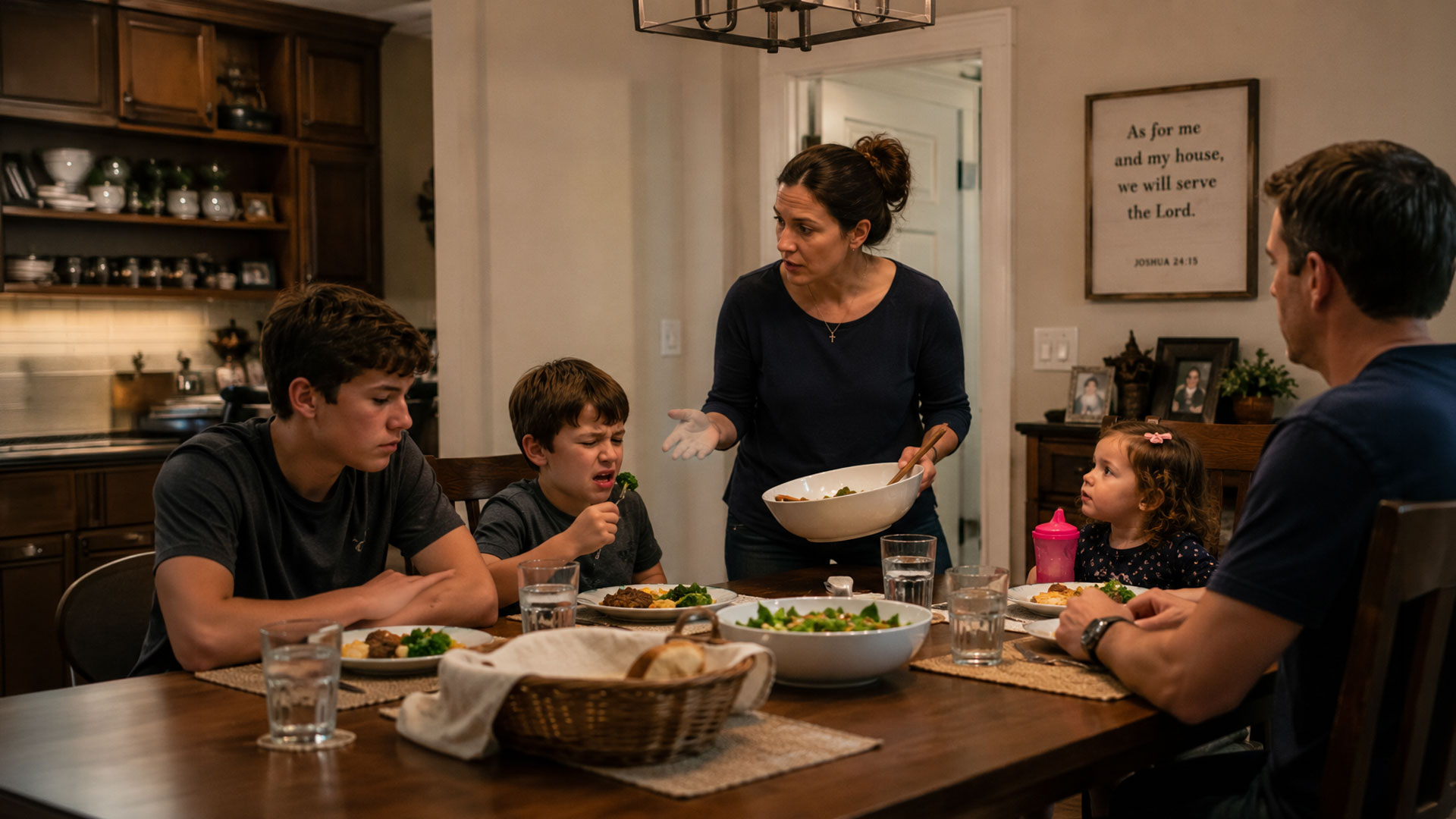
Think back to John and Theresa. Their mealtime was a “daily battle.” Christina wouldn’t stay in her chair, and Joe refused to eat until his grandfather bribed him with candy. This is the same pattern as the midnight cookies: caving to a child’s immediate desires rather than establishing a firm, loving structure.
The alternative is scheduled meals where the family eats together, where children learn to wait, and where they’re more likely to try new foods because they see everyone else eating them. They learn self-discipline as they cope with a growing appetite in anticipation of mealtime.
The same goes for order. Their morning routine was chaos, with toys scattered everywhere and parents yelling in a rush. But even a three-year-old is capable of putting away her own toys and clothes. The point isn’t to have a perfectly tidy house; it’s to give a child the satisfaction of contributing to the family.
When we affectionately insist that they complete these small tasks, we are teaching them responsibility. We are giving them “a greater capacity to want the good of the others—which is a working definition of love.” We are forming character, not just managing behavior.
A Word of Encouragement for the Tired Parent
If you’re reading this from the trenches of exhaustion, feeling a lot like John and Theresa, please hear me: this is not another thing to feel guilty about. This is a word of hope. It’s incredibly easy to fall into survival mode, to feel “seriously stretched,” and to just do whatever it takes to get through the day and night.
But you are not just surviving; you are raising a human being. The work you are doing is the most important work in the world.
Reclaiming your nights—and your parental authority—is hard. It will probably involve some tears (yours and theirs). But the struggle is an investment, not a failure.
You are not being mean or unloving when you set a firm boundary. You are being the most loving parent you can be—one who sees the big picture and is willing to endure short-term difficulty for the sake of your child’s long-term happiness and well-being.
The peace that comes when your child is sleeping soundly in their own bed is a wonderful reward for you. But it’s an even greater gift to them. You are giving them the gift of security, which comes from predictable routines and clear limits.
You are giving them the gift of self-control, the foundation of a mature and happy life. And you are giving them the gift of confidence, the deep-down knowledge that they are capable, independent, and unconditionally loved by parents who care enough to say no.