The Illusion of Control
There comes a point in parenting where your voice echoes down the hallway and, for a fleeting second, the world stands still. Kids freeze. Obedience achieved. You won. Or did you?
Yelling feels powerful. There’s adrenaline, silence, maybe even results. It works… until it doesn’t. Because while you might’ve won the battle, you’ve often lost the formation. And that’s the difference between managing children and raising adults. One focuses on control. The other on growth.
When yelling becomes the default discipline, what kids learn is simple: behave or else. It’s a transaction, not transformation. And what families actually want, even if we don’t always know how to ask for it, is not fear. Not silence. Not surface compliance. But virtue. The kind that lasts after the yelling stops.
Yelling May Win the Moment, But You Lose the Formation
Let’s tell the truth: yelling works. It interrupts chaos. It freezes behavior. It gives parents a sense of control, especially when everything feels like it’s spiraling.
But that sense of control is a mirage.
What yelling produces is reaction, not reflection. Kids may stop the teasing, the whining, the defiance, but they haven’t changed their reasoning. They’ve just calculated the risk of continued disobedience. It’s damage control, not discipline.
Yelling conditions children to monitor your volume instead of their own conscience. The question becomes, “How loud is Dad right now?” instead of, “What’s the right thing to do?”
And slowly, the tone becomes the standard. If you’re not shouting, they assume it’s not serious. Your authority is reduced to decibels.
It’s not that yelling never stops behavior. It’s that it can never form virtue. And virtue is what survives long after you’ve walked out of the room.
What Kids Really Learn When You Yell
You might think you’re teaching respect, but here’s what your child might actually be learning:
“I’m only lovable when I’m quiet.”
“Emotions are threats. Better hide mine.”
“If I want to be heard, I have to be louder than everyone else.”
“If I’m good, I get peace. If I’m bad, I lose connection.”
Over time, yelling rewires their sense of what love sounds like. And for some, that becomes normal. Later in life, they may only respond to pressure, fear, or relational tension because it’s what discipline looked like at home.
Your tone becomes part of their interior voice.
But here’s the flip side: when discipline is calm, firm, consistent, and rooted in love, it teaches a completely different script:
“I’m secure even when I mess up.”
“Dad doesn’t yell. He explains.”
“Love doesn’t vanish when I fail.”
Those are the voices that stick.
Virtue Over Victory, Why Formation Beats Control
There’s a temptation to equate quiet with success. The child who listens quickly, doesn’t talk back, and cleans up is considered well-formed. And maybe they are. But some kids comply out of fear, not strength. The virtue is skin-deep.
The goal isn’t “a kid who doesn’t talk back.” It’s a young person who knows how to speak the truth with courage, even when it’s hard. The aim isn’t “a kid who sits still.” It’s someone who understands reverence, attention, and appropriate restraint, not just obedience.
Formation takes longer. It’s slower. It demands more of you, and less noise. It means building the internal compass, not just enforcing external control.
Ask yourself:
Does my child act differently because they understand the good, or just to avoid my anger?
Do they apologize because they mean it, or because it ends the tension faster?
When you move from a yelling reflex to a formation mindset, you stop aiming for “good behavior,” and start aiming for a good heart.
Replacing Yelling with Calm Authority
You don’t have to give up authority to stop yelling. In fact, the strongest leaders are usually the calmest ones. Coaches don’t scream every play. Judges don’t raise their voices. Why? Because when your authority is clear, your tone can be steady.
Here’s what replacing yelling might look like:
Predictable systems: When the consequence is known in advance, there’s no need to shout. “You left your homework again? That’s 15 minutes off screens, same as yesterday.”
Firm tone, low voice: Whispering a warning can carry more weight than a shout across the room.
Fewer threats, more follow-through: The more often you follow through calmly, the less they’ll test the boundary.
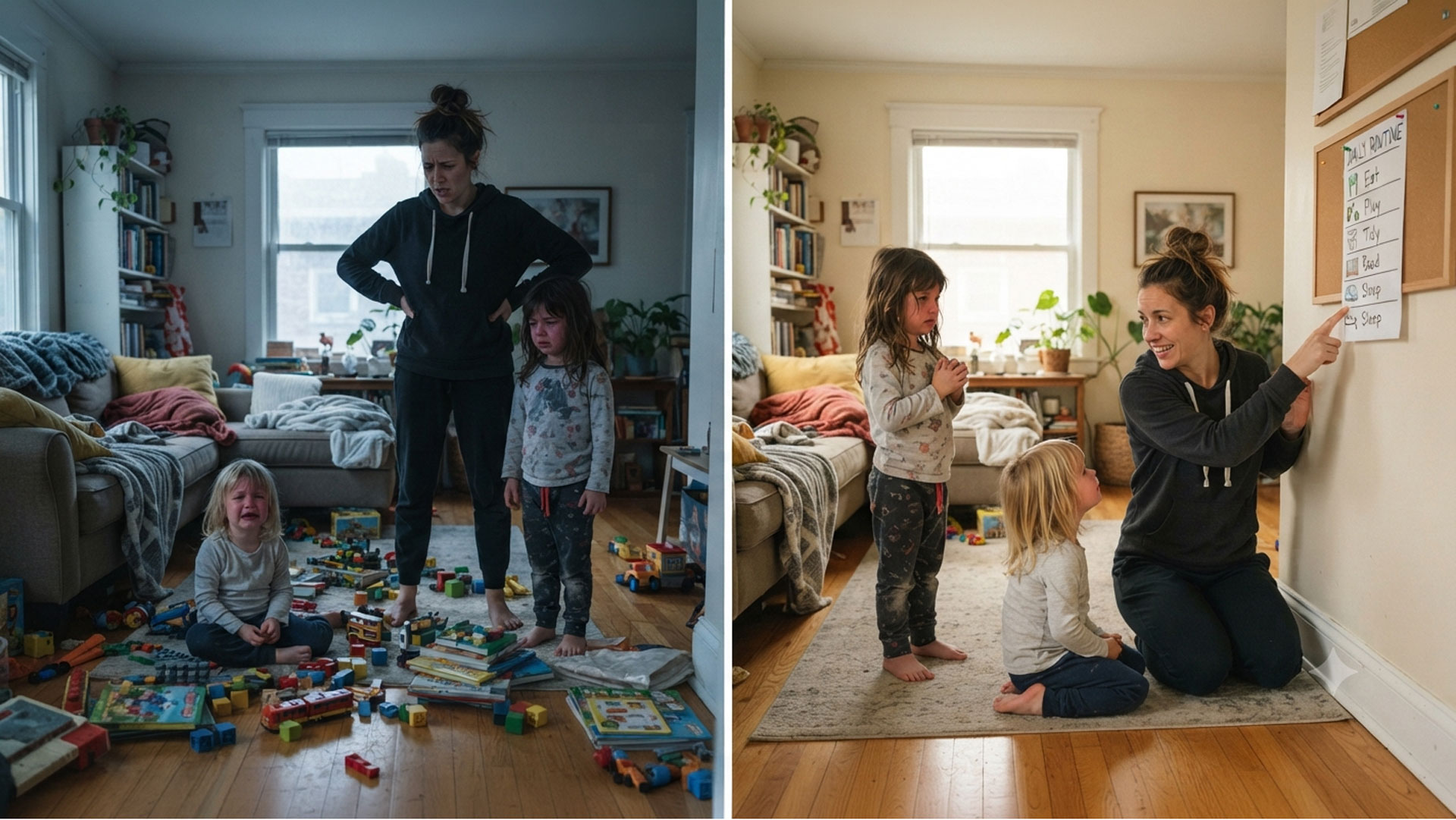
Visual reminders: Charts, routines, and written expectations reduce the “Why didn’t you, ?” conversations that spiral into conflict.
Calm authority isn’t passive. It’s just efficient. You save energy. You preserve trust. And your words carry more meaning because they’re not buried under volume.
Understanding Why We Yell
Let’s be honest. Yelling often isn’t about them. It’s about us.
It’s exhaustion, fear, frustration, disappointment. It’s feeling like everything’s unraveling and this one small act of disobedience broke the dam.
Sometimes yelling is a symptom of emotional clutter, the pile-up of unresolved stress.
Here’s a strategy: trace the moment back. Were you already running late? Skipped lunch? Argued with your spouse earlier? Most yelling moments don’t begin with the kids. They start in us. And if we don’t learn to recognize those early red flags, we become volcanoes.
Self-control starts with self-awareness. Start journaling after a hard moment:
What triggered me?
Was the behavior truly about defiance, or did it just inconvenience me?
What was I hoping would happen instead?
You’ll often find the yelling came from a fear, not of your child misbehaving, but of you failing.
But here’s the truth: You’re not failing when your kids act up. You’re only failing when you stop trying to form them with love.
When You Fail, Because You Will
You’re going to yell again. Maybe tonight.
But the moment after the yelling is where real formation can begin.
Own it. Don’t explain it away. Don’t shift blame. Just say it.
“I shouldn’t have yelled. I’m sorry. You didn’t deserve that.”
That sentence has more power than most parents realize. Because now you’re doing what yelling never could: modeling humility.
And your child will notice. They’ll learn that even parents mess up. And more importantly, that good people apologize. That authority isn’t about always being right, it’s about owning when you’re wrong.
That kind of atmosphere builds trust. It gives your kids a soft landing when they fail too.
Replacing Chaos with Rhythm
Yelling thrives in chaos. Virtue thrives in rhythm.
If you want to yell less, simplify more. A peaceful house isn’t always a quiet one, but it’s a predictable one.
Start by targeting your flashpoint zones:
Mornings: Are shoes always lost? Lunches packed late? Build a checklist. Set a five-minute music cue to signal “pack-up time.”
Homework: Same space, same time. No screens until it’s done.
Dinner prep: Can the kids help with a mini-task? Setting napkins buys you ten minutes of prep peace.
Bedtime: Same story, same order. Let routine carry the mood.
Routines don’t just reduce yelling. They replace it. Systems do the shouting for you.
And kids love rhythm. It gives them a sense of safety, structure, and dignity. It tells them: this house has order. You have a role here. You are capable.
Training the Will, Not Just the Behavior
Think of your child’s will like a muscle. You don’t grow muscle by yelling at it. You grow it by repetition, resistance, rest, and challenge.
Self-discipline comes from practice, just like soccer, piano, or prayer.
Start small:
Let them finish the chore they complained about.
Have them hold the door with a smile.
Ask them to speak last in a conversation.
Invite them to serve someone without reward.
Each of these is a “rep.” A rep of generosity, perseverance, patience.
And when they resist, don’t react. Coach. Step into the role of guide.
“This is hard, I know. But you’re capable. Let’s try again.”
This communicates belief, not just boundary. And kids rise to what we believe they can be.
A Faith-Filled Framework: God Doesn’t Yell
Now let’s get real quiet. Because the most powerful example of all isn’t you, it’s the One you represent.
God doesn’t yell.
He speaks in whispers. In clarity. In consequence. In silence that invites conversion. His discipline is never panic. It’s always invitation.
As parents, especially fathers, we stand in that space. And our voice becomes, for a time, the first impression of justice and mercy.
When you choose a calmer path, you’re not just improving your parenting. You’re shaping their image of how love disciplines.
That’s not a burden. That’s a privilege.
Raising Adults, Not Just Obedient Kids
It’s easy to focus on the immediate win. A clean room. A quiet car ride. A fast apology.
But what matters most isn’t tonight. It’s ten years from now.
Will your child know how to regulate their emotions? Will they know how to confess when they mess up? Will they associate discipline with clarity, consistency, and care?
Yelling might get you to bedtime. But it won’t get your child to adulthood.
The endgame is a person who can lead, love, and sacrifice. Someone who seeks truth, even when no one’s watching. Someone whose habits are rooted in virtue, not fear.
So keep showing up. Keep forming their hearts. Keep walking the slow road of rhythm, not reaction. Let your presence carry the authority, not your volume.
And if you yell tomorrow?
You get up again. Apologize again. Love again. Lead again.
Because the best parenting isn’t perfect. It’s faithful.